

In recent years, massive price swings have pushed gold, the ultimate traditional asset, back into the spotlight. In 2025, gold prices surged by over 50%, and this January, they even smashed through the $5,000/oz milestone, briefly touching nearly $5,600/oz. However, since March, as Middle East tensions boiled over and energy prices took a hit, gold prices took a nosedive, wiping out all of this year's gains. This dramatic plot twist made the term Gold Monkey Market go viral on social media. Running parallel to this is the hot narrative of Gold Tokenization. On the other side of the financial world, people are busy exploring the many possibilities of gold on the blockchain.
On March 19, the World Gold Council announced plans to build a new shared infrastructure for the digital gold market and introduced the Gold as a Service concept. This involves developing a digital issuance and management system that links physical gold custody with gold-backed products, aiming to provide a standardized system for issuing, trading, and managing various types of digital gold. Meanwhile, tokenized gold assets like PAXG and XAUt have evolved from mere concepts into large-scale markets, with major institutions speeding up their strategic moves in this space.
Gold tokenization offers a fresh way to express the value of traditional gold. Compared to physical gold and other gold products, tokenized gold has a much lower entry barrier and supports 24/7 trading. It also protects investor rights through standardized custody, third-party audits, and redemption mechanisms, offering a safe and convenient alternative investment channel. Because of this, many people believe gold tokenization will be the next dark horse in the RWA sector.
Is gold tokenization a dark horse or just hype? This is a question worth thinking about. To find the answer, we can't just rely on hype; we need to look at three key issues: Since gold already has many forms, how does tokenization differ from physical gold or Gold ETFs, and does it offer real functional value? Have the market and regulatory systems for tokenized gold become transparent enough to earn investor trust? And what unavoidable risks do project teams and individual investors face when planning to jump into tokenized gold?
Tokenized Gold refers to using blockchain and smart contract technology to move the ownership, beneficial rights, or other economic interests of physical gold onto the chain as digital tokens. Usually, each token is pegged to a specific weight of physical gold, which is kept in a vault by a gold custody institution. Since these gold tokens live on the chain, users can send them to other wallets or trade them on-chain just like any other cryptocurrency.
The workflow of gold tokenization involves several key parts: (1) Custody: The project team buys physical gold and stores it in a secure, insured vault to ensure the digital tokens are backed by real-world assets; (2) Minting: The project team uses smart contracts on the blockchain to mint digital tokens, with the number of tokens matching the amount of gold in reserve; (3) Redemption: Some gold tokenization projects allow for physical redemption. When a user swaps tokens for physical gold, the system burns the corresponding number of tokens to keep the supply in sync with the gold reserves; (4) Reconciliation, Auditing, and Attestation: To maintain trust in a decentralized system, project teams hire independent third-party auditors for regular checks and verification. Some projects also use oracle networks to provide Proof of Reserve.
Take Tether Gold (XAUt) as an example. Each XAUt token represents ownership of one troy ounce (31.1035 grams) of gold held in a Swiss vault that meets London Bullion Market Association (LBMA) delivery standards (usually 99.9% purity). The operating entity, TG Commodities, buys physical gold from the Swiss market and puts it in the vault. Investors can check the unique serial number, weight, and purity of specific gold bars through a blockchain address. There are two ways to redeem: first, by redeeming the full physical gold bar, which requires the user to hold a minimum amount of XAUt; second, through regulated channels like Bitfinex to swap XAUt for USD or Tether (USDT).
Currently, the market is dominated by Tether Gold (XAUt) and PAX Gold (PAXG), which hold the lion's share of the market. At the same time, there are non-mainstream gold tokens like Kinesis Gold (KAU), Pleasing Gold (PGOLD), and Matrixdock Gold (XAUm) that have built advantages through niche competition, though their scale is relatively small. Additionally, the World Gold Council plans to launch a token called Pooled Gold Interests (PGI) in 2026. This will use a trust interest model, which is different from the physical collateral structure of mainstream tokens like XAUt and PAXG, further diversifying the market under the current duopoly.
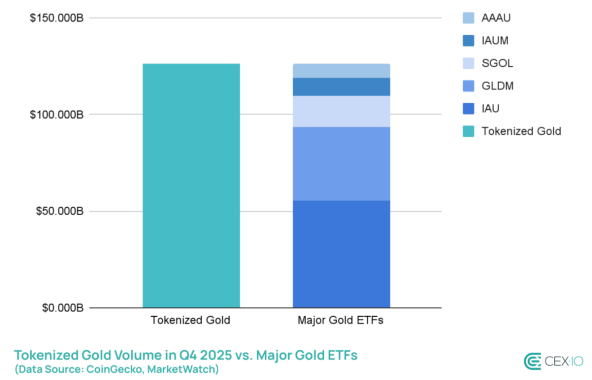
In terms of market size, according to statistics from Rwa.xyz, as of April 17, 2026, the total market cap of tokenized gold reached $5.27 billion. A research report from Cex.io shows that the total trading volume of tokenized gold in 2025 hit $178 billion. By the fourth quarter, volume spiked to over $126 billion, far exceeding any previous period and even slightly higher than the total of the top five Gold ETFs combined. The investor base is also growing, with the number of tokenized gold holders increasing by over 115,000 in the past year—a growth rate 14 times faster than in 2024.
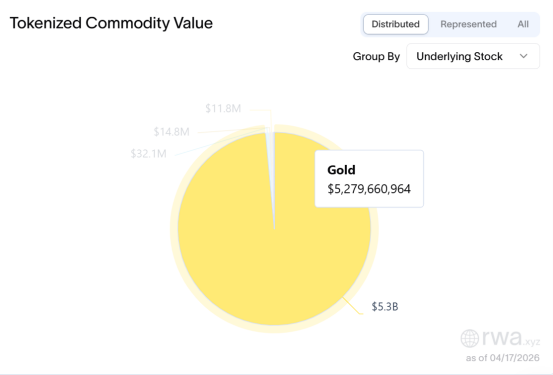
Regarding application prospects, the continuous entry of financial institutions is driving the expansion of the tokenized gold market. The rollout of tokenized gold has also created new business innovation space for both traditional financial institutions and emerging crypto-finance platforms. The ETP market maker Flow Traders has launched a 24-hour OTC liquidity service for tokenized assets, enabling efficient cross-platform trading for popular assets like tokenized gold. Meanwhile, we see the tokenization of Hang Seng Gold ETFs and Hex Trust helping HSBC bring gold assets onto the chain. In the future, tokenized gold might become the "anchor asset" for on-chain portfolios, kicking off a true era of on-chain asset management.
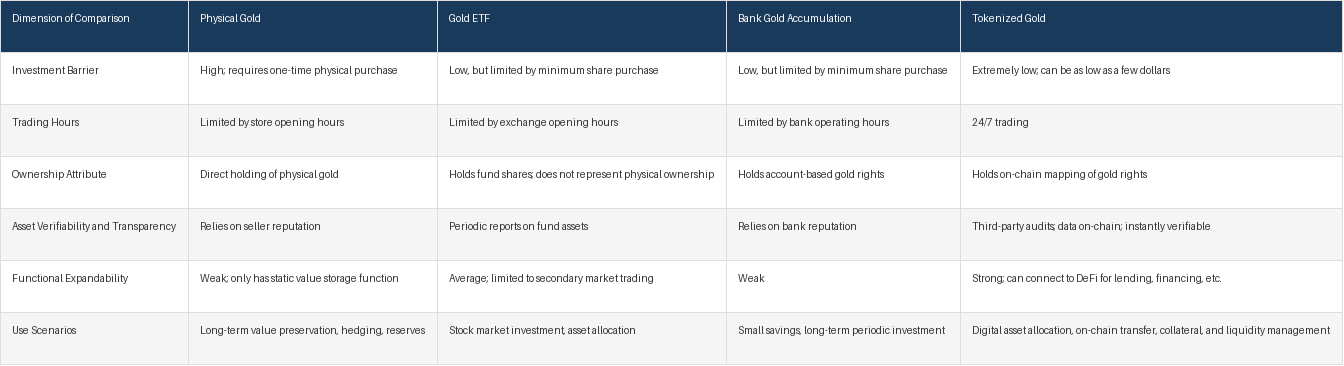
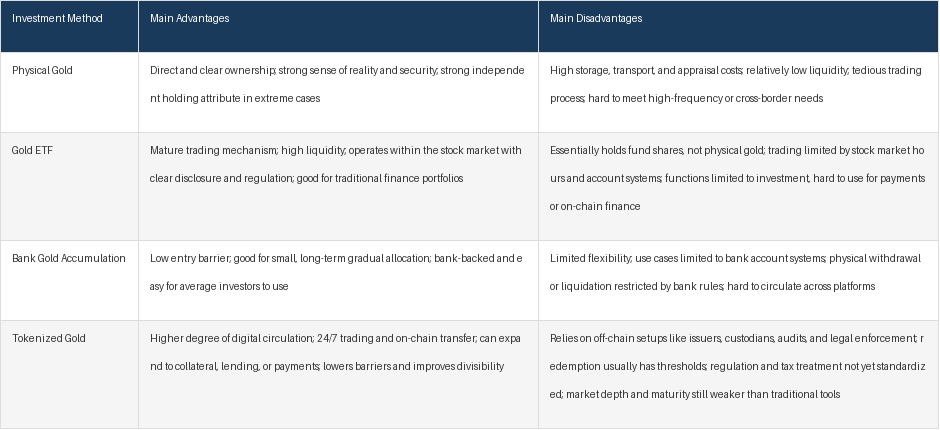
As a traditional safe-haven asset, gold plays a vital role in investment portfolios. Besides tokenized gold, the main ways investors get exposure to gold include physical gold, Gold ETFs, and bank gold accumulation plans. Physical gold exists as bars, coins, or jewelry—the most traditional and direct method where investors buy and hold the actual gold with clear ownership and a visible asset form. Gold ETFs (Exchange Traded Funds) are listed on stock exchanges; investors buy and sell shares through brokerage accounts, and these shares are backed by physical gold, providing indirect returns based on gold price moves. Gold accumulation plans are products offered by commercial banks where investors can build up gold holdings by amount or weight through periodic or lump-sum purchases managed via an account. Different gold investment tools vary in ownership structure, trading methods, and use cases, leading to their own pros and cons.
While Gold ETFs and similar products offer more efficient trading compared to the storage hassles and high craftsmanship fees of physical gold, they still suffer from pain points like multi-layered centralized clearing intermediaries, trading delays, and restricted trading hours. Tokenized gold offers innovative solutions to these issues: First, by linking digital tokens to physical gold, it provides gold investment functions similar to traditional products like Gold ETFs but further lowers the entry barrier through fractional ownership. Second, it breaks free from trading hour limits, supporting instant, high-frequency trading with management fees that are generally lower than traditional products. Theoretically, investors can get better liquidity at a lower cost. Third, it expands the source of returns for gold investment. Tokenized gold is expected to move beyond traditional functions like diversification and value storage to become deployable capital, sparking new application scenarios like gold staking and lending. Besides profiting from the price spread, investors might also enjoy yields brought by DeFi.
Different investment tools exist because of diverse needs; it is not a case of one form completely replacing the others. However, there is no doubt that tokenization creates new possibilities for acquiring and trading gold. During the market closures of traditional products like gold futures and ETFs, tokenized gold plays a crucial price discovery role. As a long-standing hard currency of the market, gold has become easier to get and trade thanks to tokenization. Whether it is about enriching investor choices or helping gold assets integrate into the modern financial system, tokenization holds unique value.
Global regulatory policies for tokenized gold show a diverse landscape. Different countries and regions have formed their own local policy models based on their financial infrastructure, market environment, and regulatory styles.
(1) United States: The US has not yet issued specific regulatory documents for tokenized gold. Generally, if the issuance or sale arrangement of tokenized gold meets the criteria for an investment contract (the Howey Test), it is treated as a security. Its issuance and trading are then governed by the Federal Securities Act, including obligations for information disclosure and investor suitability management, all under the supervision of the Securities and Exchange Commission (SEC). Additionally, tokenized gold might be classified as a "commodity," putting it under the jurisdiction of the Commodity Futures Trading Commission (CFTC).
(2) Europe: Tokenized gold development in Europe is characterized by legislative leadership, attempting to find a balance between innovation and regulation. The EU is pushing acts like DORA and MiCA to regulate token business. Member states like Luxembourg, Germany, and Switzerland have also set up pathways, providing special regulatory sandboxes for RWA. However, exactly which regulations tokenized gold falls under still depends on the specific architecture and asset substance of the project.
(3) Hong Kong, China: If a tokenized gold project is classified as a "security token," it falls under the Securities and Futures Ordinance (SFO). Issuers must comply with prospectus requirements or private placement exemptions and implement customer due diligence and fund source reviews according to the Anti-Money Laundering and Counter-Terrorist Financing Ordinance (AMLO). Furthermore, providing issuance or trading services requires a VASP license under the virtual asset service provider licensing regime.
As the wheels of technical innovation roll forward, complex compliance issues are becoming more prominent. First, the sufficiency of underlying assets forms the basic credit for gold tokens. Whether the project architecture and audit mechanisms can effectively control underlying asset risks is the primary problem for project teams. This requires project teams to ensure that physical gold ownership is clear and free of defects, paying attention to whether the gold has other rights like mortgages or pledges when purchasing. The source and quality of the gold must undergo strict verification and regular third-party audits. Furthermore, there should be full, true, and timely information disclosure regarding underlying asset details, risk factors, and return mechanisms to avoid regulatory penalties and class-action lawsuits due to false statements or omissions. Second, cross-border compliance and continuous operations also challenge the compliance capabilities of project teams. Gold is globally liquid, and the places of issuance, custody, and investor residence might be in different countries, subject to multiple legal jurisdictions. This requires project teams to systematically map out regulatory requirements triggered by their business actions. Finally, in terms of taxation, the legal and tax classification of tokenized gold is still blurry. The nature of the income from tokenized gold projects will directly affect the applicable tax types and burdens. Meanwhile, from the asset end to the trading end, tokenized gold projects might trigger tax obligations at multiple stages like issuance, profit distribution, and secondary market trading. This requires project teams and investors to stay updated on tax policies and seek professional help for reasonable tax planning.
Gold tokenization might be one of the most eye-catching intersections between traditional finance and Web3 this year. Returning to the question at the start, gold tokenization is neither a meaningless case of "old wine in new bottles" nor a dark horse you can bet on without caution. On one hand, it improves the accessibility and liquidity of gold, offering special value compared to traditional investments, and has already formed a market of considerable scale. Driven by global policies and institutional moves, it has great potential. On the other hand, we must realize that the value foundation of tokenized gold is still being built. Factors like underlying asset security, the quality of third-party audits, disclosure and redemption mechanisms, and the global regulatory framework will all determine whether it can win a spot in the fierce market competition. In any case, the future of gold is being rewritten on the blockchain, and all of this is happening right now.

FinTax offers crypto accounting suite, tax calculator and professional tax consulting services.